
Conquering the Deep Hole: How Brightstar Machines High Aspect Ratio 28:1 Parts in Stainless Steel 316L
Pain Point Analysis: The Physical Limits Hidden Behind "Just Drilling a Hole"
In rapid prototyping and precision CNC machining, we often find that the real technical barriers lie in the most basic processes. Drilling, the most fundamental method of material removal, becomes exponentially harder when specific materials and extreme geometries are involved.
Recently, Brightstar successfully completed and shipped a batch of highly anticipated low-volume turned parts. The material was Stainless Steel 316L, known for its excellent corrosion resistance and strength, but also notorious for its work-hardening tendency and poor machinability. However, the real challenge wasn't just the material; it was the geometry — an Aspect Ratio of 28:1.
To a layperson, this is just a number. To a mechanical engineer or a veteran machinist, this is a red flag that makes many shops walk away. When drilling depth exceeds 5 times the diameter, we enter "deep hole drilling." When the ratio exceeds 20:1, standard strategies fail completely. It is no longer about rotation and feed; it is a delicate balance of rigidity, tribology (chip evacuation), and dynamics (vibration).

Industry Benchmark: Defining Aspect Ratio and the "Critical Zone"
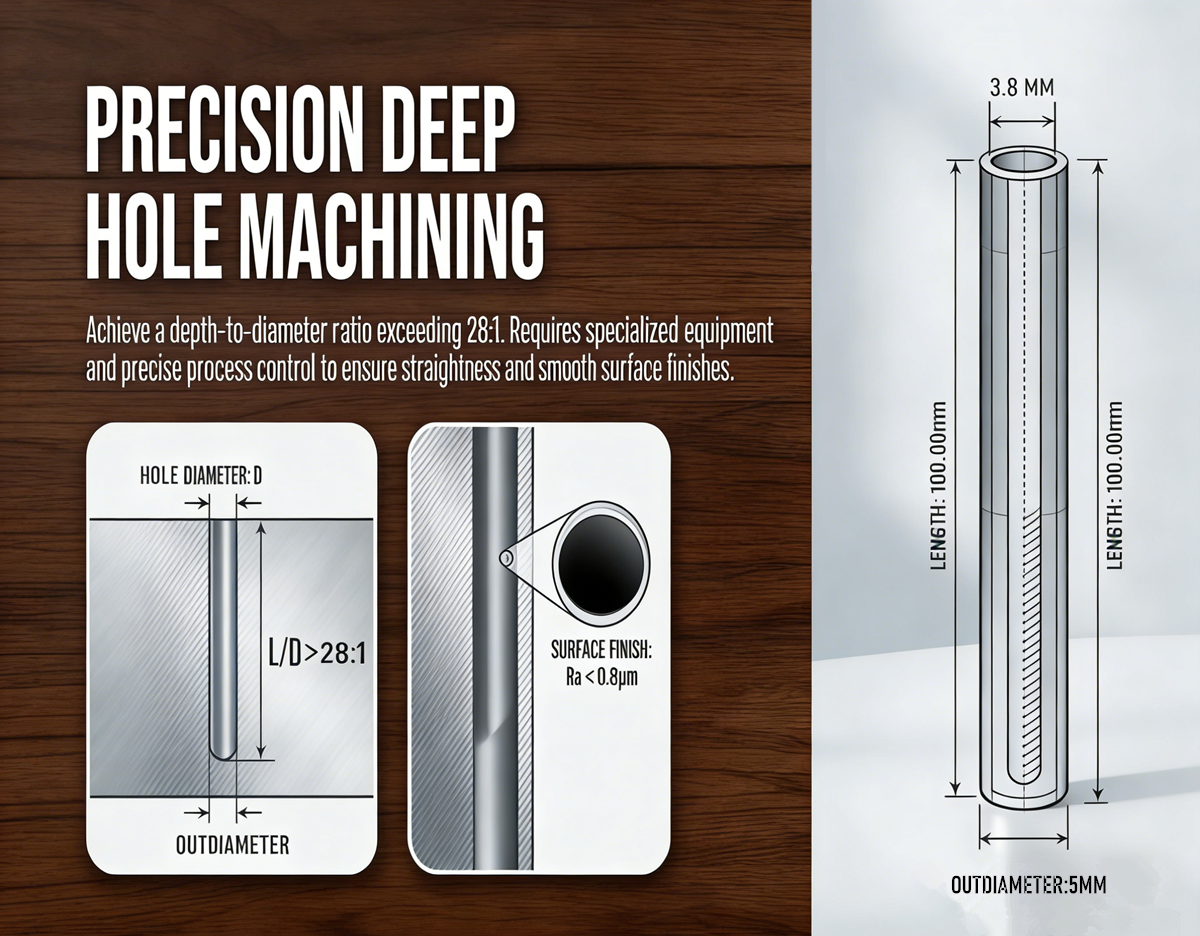
To quantify this difficulty, we need a clear coordinate system. In precision manufacturing, the Length-to-Diameter Ratio (L/D Ratio) is the core metric for hole difficulty.
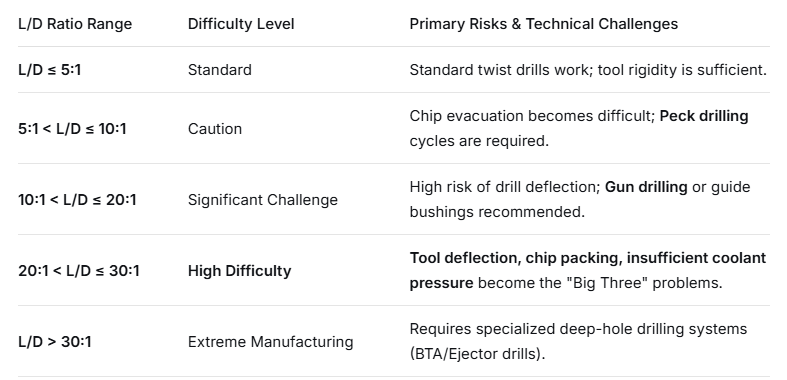
A ratio of 28:1 sits right at the upper edge of the "High Difficulty" zone. To visualize this, if you are machining a 5mm diameter hole, you are drilling to a depth of 140mm. This 140mm wall must maintain extreme straightness, surface finish, and absolutely no taper or bending.
Deep Dive: What We Did to Counter Tool Deflection and Chip Jamming
At Brightstar, we don't believe in luck; we believe in rigorous Process Design. For this 316L project, we faced three primary threats:
Tool Deflection: At 28:1, a standard long drill behaves like a strand of spaghetti. When it contacts the workpiece, radial forces cause it to "walk" or deflect rather than penetrate, leading to positional deviation or a bell-mouthed entrance.
Chip Packing: 316L produces gummy, stringy chips that are hard to break. At 140mm depth, chips cannot rely on simple helical flutes to exit. Once packing occurs, torque spikes, resulting in drill breakage inside the part — often leading to immediate scrap.
Coolant Failure: Without high-pressure through-coolant, standard drills cannot get fluid to the cutting edge. In this enclosed space, localized heat causes rapid work-hardening of the 316L, which subsequently "chews up" the drill edges.
Our solution was not just a tool; it was a complete process system.
Solutions & Flowchart: The Art of Guiding, Not Just Drilling
For this order, we activated our special process protocol for high-precision deep hole machining. The diagram below illustrates our standard logic flow for such high L/D parts.
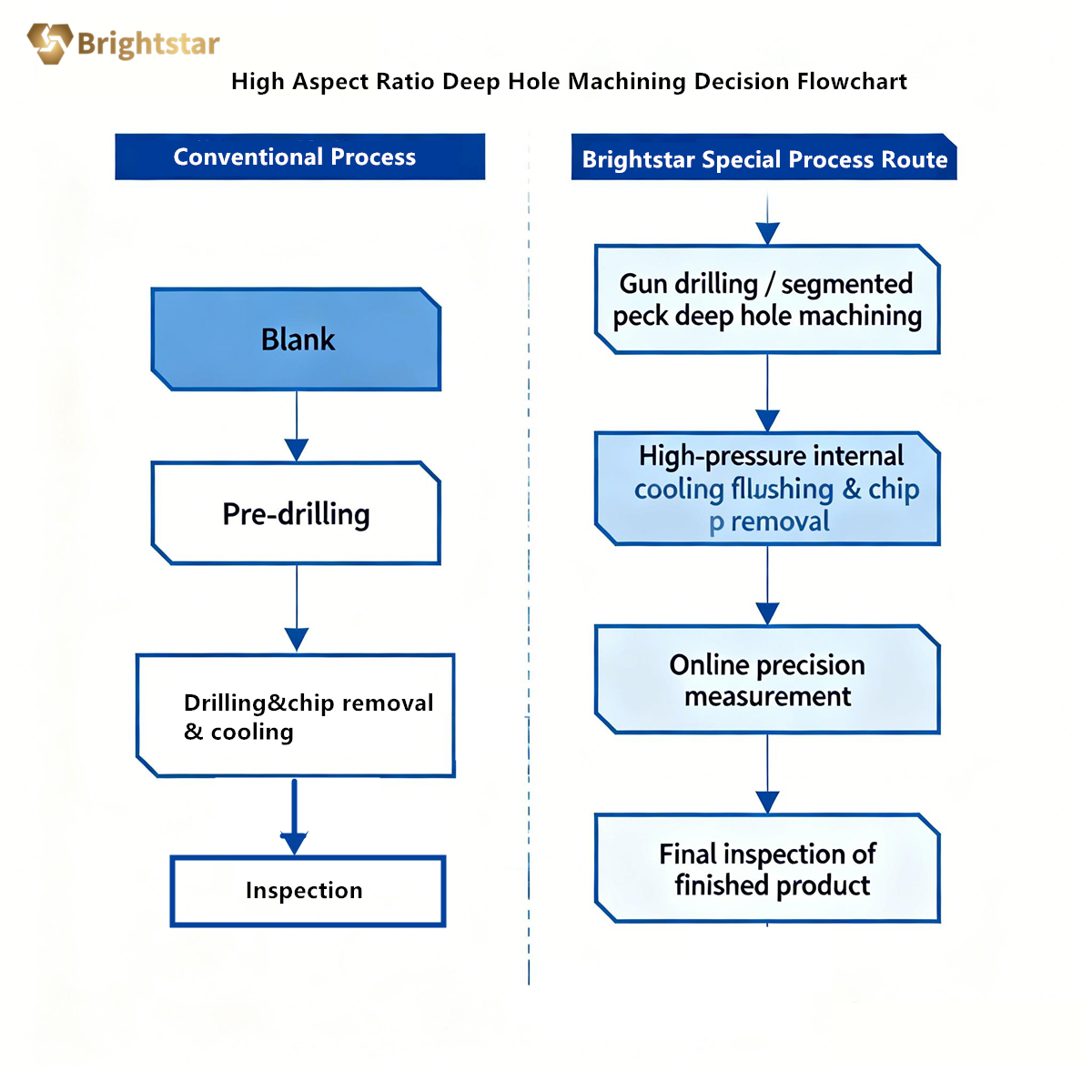
Key steps implemented:
Step 1: Rigid Pilot Guiding
We did not start with a 28:1 long drill. We used a short, ultra-rigid spotting drill to create a pilot hole 2-3x the diameter deep. This acts as an absolutely precise "gun barrel" support for the subsequent long tool, preventing entry deflection.
Step 2: Pecking & Intelligent Retraction
Optimizing the Peck Drilling cycle. While traditional pecking drills deep and retracts, that is too late for 28:1. We used a "high-frequency, short-distance" retraction strategy, withdrawing the drill completely every 0.5mm to 1mm of progress. This breaks chips and allows high-pressure coolant to jet to the bottom, flushing out suspended debris.
Step 3: Specialized Through-Coolant Tooling
We selected specialized deep hole drills with parabolic flutes and through-coolant holes. By adjusting feed rates, we ensured chips formed small "C" shapes or short spirals rather than long tangles. We lowered RPM to suppress vibration while maintaining feed to preserve the "squeezing" cutting action, avoiding friction-induced work hardening.

Case Study: When Stainless Steel 316L Meets the 28:1 Challenge
Background: A European medical device developer needed precision valve spools for fluid control. The material had to be 316L (resistant to steam sterilization), requiring surface finish (Ra ≤ 0.8μm).
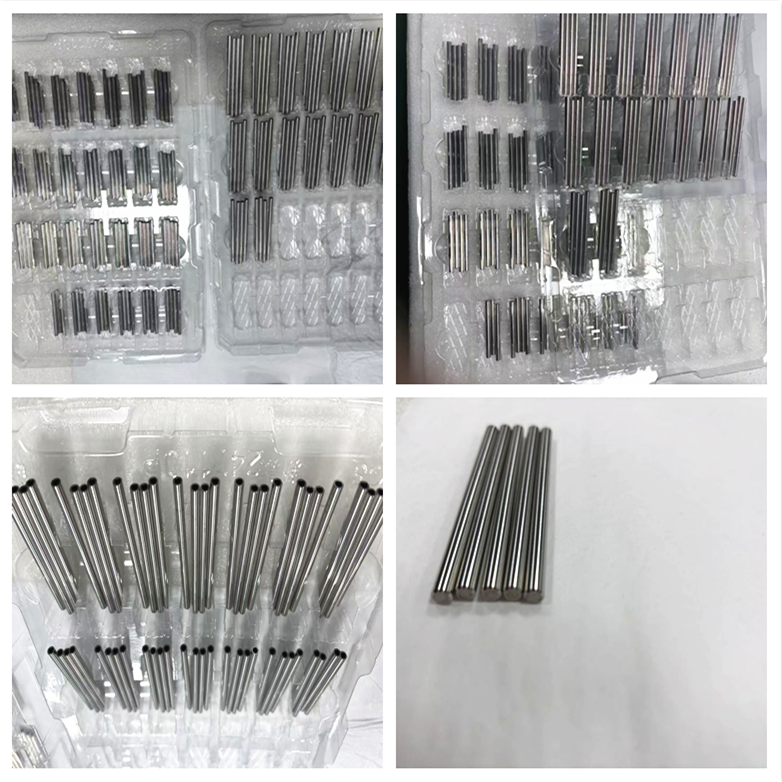
Brightstar Execution Data:
Equipment: High-rigidity CNC Turning Center (with high-pressure cooling system).
Process: Pre-drilling + Gundrilling + Reaming/Roller burnishing.
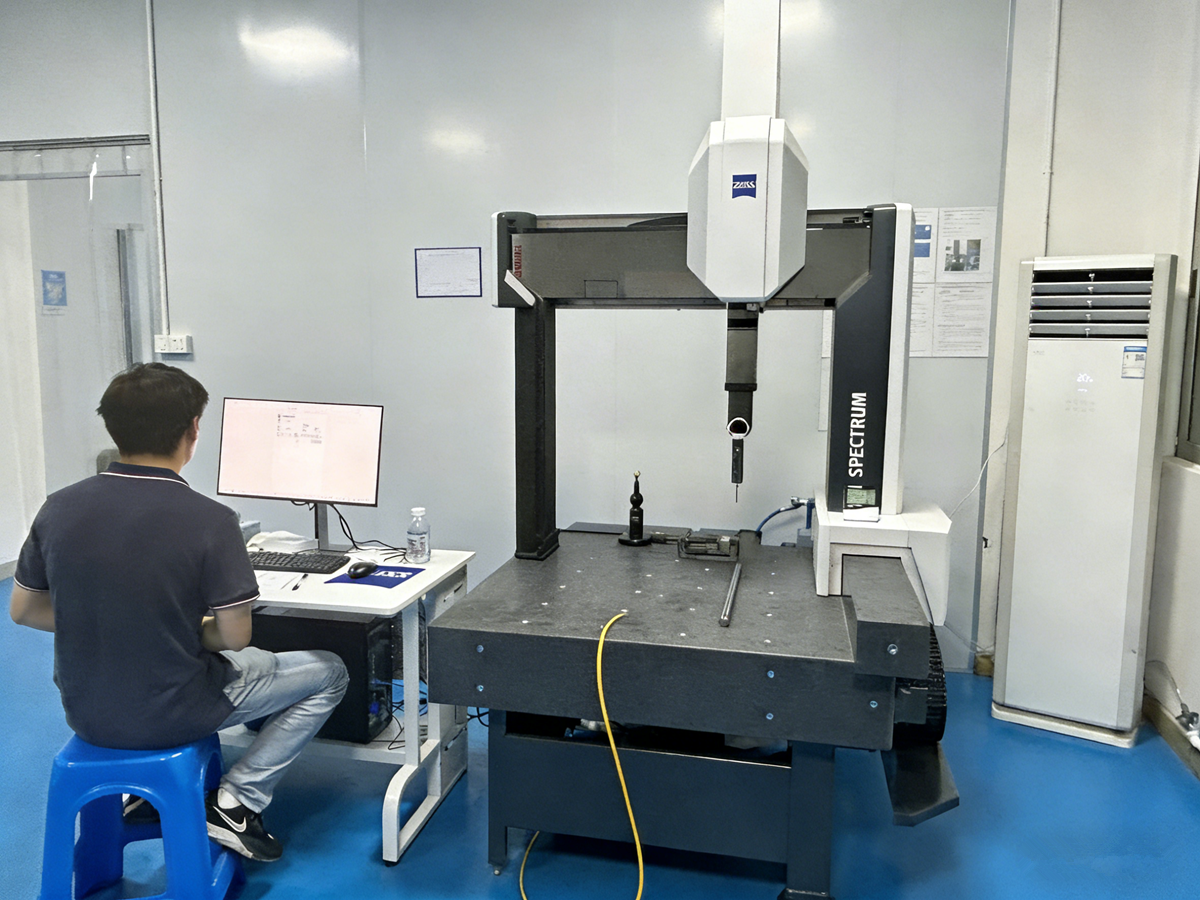
Inspection: Air gauging for 100% inspection; Industrial endoscope for microcosmic surface verification.
Result: In continuous low-volume production, we achieved 100% on-time delivery with zero quality defects. With no visible spiral marks or chatter. After receiving the first samples, the client was completely satisfied.
This proves our philosophy: In rapid prototyping, speed matters, but the process capability to solve high-difficulty problems builds lasting trust.
Why Global R&D Teams Choose Brightstar
Founded in 2009 with over 6,000 square meters of modern facilities, Brightstar is not just a job-shop. We are a one-stop rapid manufacturing solutions provider.
Hardware Strength: We operate over 100 precision CNC machining centers, including DMU 95, DMU 65, and Hermle 5-axis equipment. The high rigidity spindles and thermal stability are the foundation for straight holes.
Certification: We strictly adhere to the ISO 9001:2015 quality management system. Every deep hole part is traceable.
Engineering Team: Our team excels in DFM (Design for Manufacturing) analysis. When we receive your 3D drawing, we don't just quote; we simulate toolpaths to predict risks like "High L/D ratio" and provide optimization advice before cutting starts.
Core Commitment: We do not promise miracles, but we promise transparent communication and rigorous process control. If we identify a risk, we will tell you and propose constructive modifications or dedicated process solutions.
FAQ: Top 3 Questions Designers Ask About High L/D Holes
Q1: Do all deep holes require expensive special equipment (like Gun Drills)?
A: Not always. For L/D ratios under 15:1 in free-cutting aluminum or brass, we can use optimized peck drilling and high-pressure coolant on standard CNCs. However, for L/D > 20:1 in stainless steel, titanium, or Inconel, Gundrilling is the most economical long-term solution because it minimizes the hidden cost of scrapped parts.
Q2: How can I reduce costs if my design requires a 28:1 deep hole?
A: Consider a Stepped Hole design. If structural integrity allows, use a larger diameter for most of the depth, keeping the tight precision diameter only at the interface surface. This drastically reduces machining time and risk.
Q3: How do I verify if a machine shop can handle high L/D deep holes?
A: Ask about their chip evacuation strategy and coolant pressure. An experienced shop will immediately tell you the Bar (or PSI) of their high-pressure through-coolant and their retraction frequency logic. If they only say "we have long drills," be cautious.
Let's Solve Your Design Constraints
At Brightstar Prototype CNC Co., Ltd, we love challenges. Whether it's complex impellers requiring 5-axis machining, or precision 316L deep holes with a 28:1 aspect ratio like today, we treat every project as a stage for precision manufacturing art.
What is your next prototype or low-volume production project?
Don't let "difficult holes" be the bottleneck for your product performance.
Send your drawings to us. Our engineering team will provide you with a detailed quote including DFM feedback and feasibility analysis within 24 hours.
References
Brightstar Prototype CNC Co., Ltd. LinkedIn Company Profile & Technical Posts. 2024-2025.
Fictiv. CNC Machining Design Guide: Drilling Best Practices. 2021.