
What should a professional CNC machining RFQ include?
In the precision machining industry, a high-quality RFQ (Request for Quote) is the cornerstone of project success. It is not just a price inquiry, but a technical document that communicates design intent, conveys technical requirements, and establishes cooperative trust.
As a company that has been focusing on high-precision CNC machining and rapid prototyping since 2009, Brightstar Prototype CNC Co., Ltd always firmly believes that "quality builds long-term trust." We handle various types of inquiries from global customers every day (especially from the US, Japan, and German markets). From a manufacturer's perspective, a well-prepared RFQ can double the quoting speed, significantly improve quoting accuracy, and greatly reduce repeated communication caused by unclear information.
Today, we will systematically outline the components of a professional CNC machining RFQ for you, combining industry standards and practical experience.
Why does RFQ quality directly affect project success?
Many procurement and design engineers ask: why do some inquiries receive replies on the same day, while others take several days? The answer often lies in the details of the RFQ.
An incomplete RFQ puts the supplier in a dilemma: either stop work to repeatedly confirm, or quote based on incomplete assumptions. The former slows down the entire project progress, while the latter may lead to inaccurate quotes—which are later compensated through "change orders," ultimately resulting in even higher costs.
A high-quality RFQ is the foundation for suppliers to quickly understand requirements, accurately estimate production cycles, and provide competitive prices. It reflects not only the standardization of the procurement process, but also respect for the supplier's professional capability. For manufacturers like Brightstar that value service experience, a clear RFQ also enables us to provide valuable DFM (Design for Manufacturability) feedback at the earliest opportunity, helping you optimize structures, avoid risks, and reduce costs during the design phase.
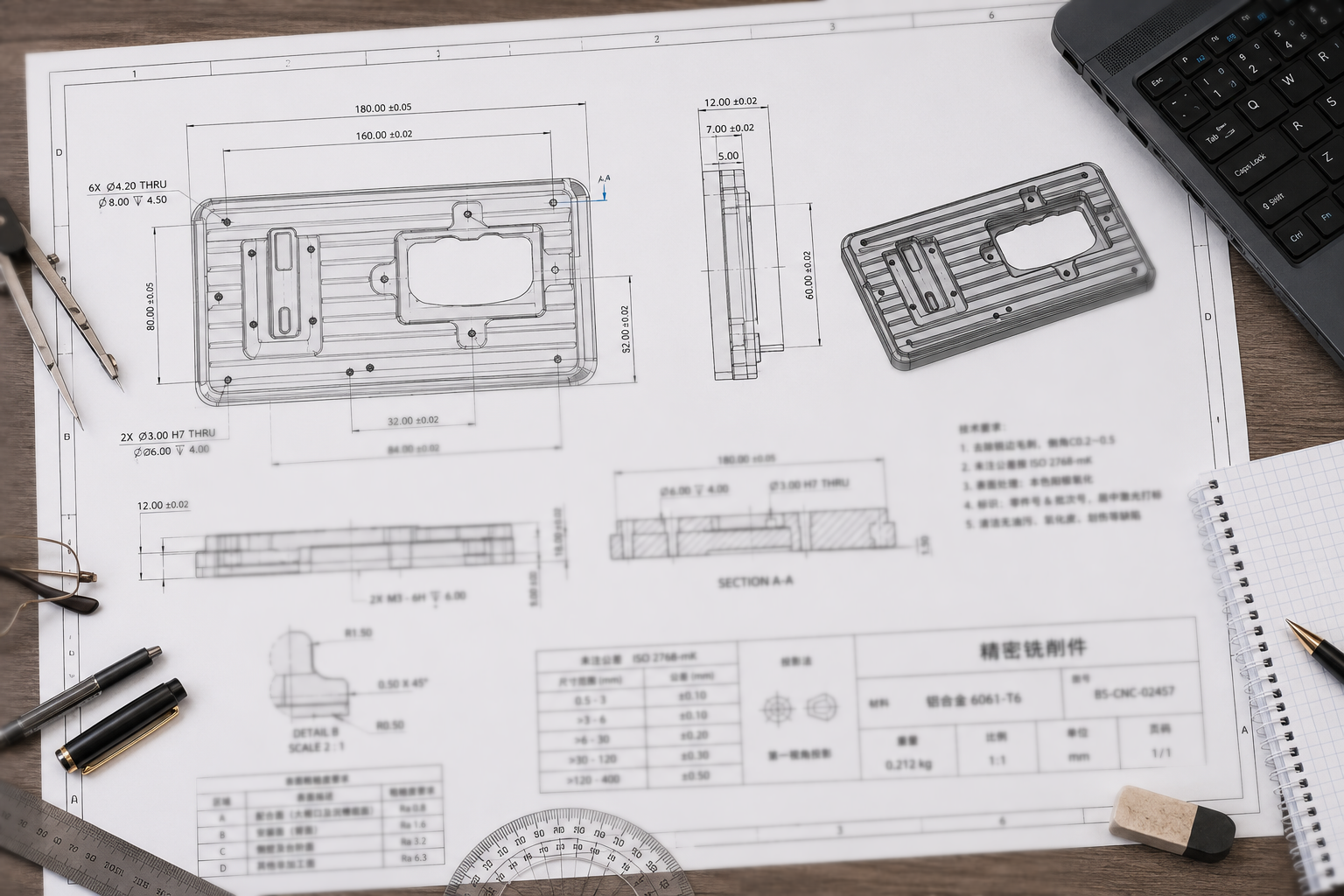
The six core elements of a professional RFQ
Common pain point analysis: why are RFQs often rejected?
Industry data and cost driver comparison
Solutions: how to prepare a "zero-question" RFQ?
Process flowchart and DFM key points
Case study: how one RFQ saved 20% in costs?
Frequently Asked Questions (FAQ)
Common "pitfalls" in RFQs
In actual work, we often encounter the following types of typical problems, which are often the culprits behind quoting delays and inaccurate cost estimates:
Pitfall 1: Drawing and model mismatch
This is the most common and most fatal low-level error. When the dimensioning on the 2D drawing conflicts with the geometry of the 3D model, the supplier has no choice but to stop and ask for clarification, wasting time for nothing. Different suppliers may understand the conflict differently, making it impossible to compare quotes horizontally.
Pitfall 2: Vague material description
Writing only "aluminum" or "stainless steel" is far from enough. The machinability, tool life, and cost of aluminum alloy 6061-T6 and 7075-T651 are vastly different; even for the same stainless steel, the cutting characteristics of 303 and 304 are completely different.
Pitfall 3: Over-constrained tolerances
Covering the entire drawing with ±0.01mm tolerances will significantly increase unnecessary machining and inspection costs. In fact, non-mating surfaces can use general tolerance standards such as ISO 2768. Tightening tolerances drives up costs exponentially, and most critical features only account for 10%-20% of the drawing's features.
Pitfall 4: Ignoring design for manufacturability
Deep cavities, small-radius internal corners (R-corners), or extremely narrow slots appearing in the design drawing force the supplier to use non-standard tools with excessive length-to-diameter ratios, reducing machining rigidity and greatly extending machining time.
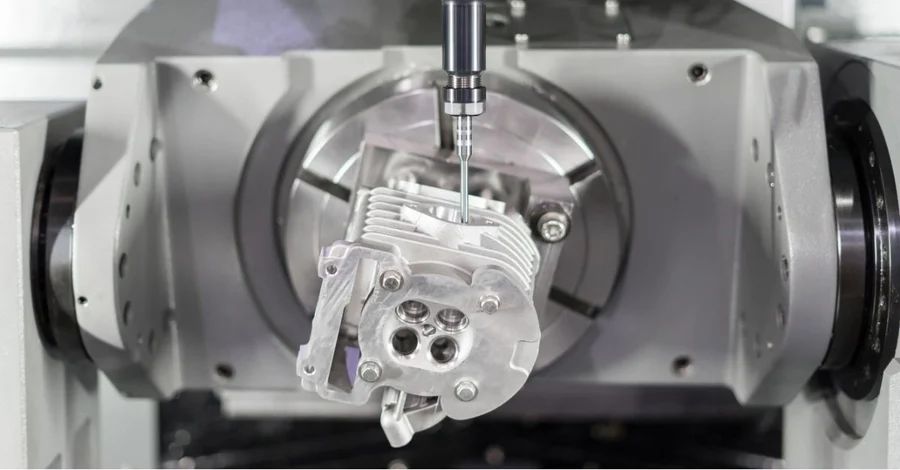
Pitfall 5: Not considering secondary operations and inspection requirements
Surface treatments (such as anodizing, plating) and inspection requirements (such as FAI, material certificates) are often raised only after the quote is given, causing the original quote to become invalid or incurring additional costs.
Industry data: which factors truly drive CNC machining costs?
To help you optimize your RFQ more precisely, here is a comparison of cost drivers based on industry practice summaries:
| Cost Driver | Low Impact (Lower Cost) | High Impact (Significantly Increased Cost) | Remarks |
|---|---|---|---|
| Tolerance Accuracy | Above ±0.1mm (general tolerance) | ±0.005mm (precision grinding/high-precision machining) | For each order of magnitude improvement in accuracy, processing time and inspection costs increase exponentially |
| Surface Roughness (Ra) | Ra 3.2μm (conventional milling) | Below Ra 0.4μm (grinding/polishing required) | High surface finish requirements mean slower feed rates and additional processes |
| Material Grade | 6061-T6 Aluminum, 303 Stainless Steel | 7075-T6 Aluminum, 17-4PH Stainless Steel, Titanium Alloy | Difficult-to-machine materials reduce tool life and require more conservative cutting parameters |
| Internal Corner Radius | R ≥ 3mm (standard tools can be used) | R < 1mm (special small-diameter tools required) | Small-diameter tools have poor rigidity, requiring reduced cutting depth and feed rate |
| Hole Depth-to-Diameter Ratio | Depth-to-diameter ratio ≤ 3 (standard drill bits) | Depth-to-diameter ratio > 6 (special deep hole drilling or EDM required) | Deep hole machining has difficult chip evacuation, high risk of tool breakage, and requires multiple peck drilling cycles |
| Number of Clamping Operations | Completed in one clamping (3-axis machining) | Multiple clamping operations or 5-axis simultaneous machining required | Each additional clamping operation increases cumulative positioning error and working hours |
Key conclusion: clearly specifying "critical features" and "non-critical features" in the RFQ, and allowing suppliers to adopt more economical machining strategies in non-critical areas, is the most effective way to control costs.
Solutions: the six core elements of a professional RFQ
Combining authoritative industry standards and Brightstar's practical experience, we recommend that you must include the following six modules in your RFQ:
1. Complete engineering files (2D drawing + 3D model)
What to submit:
3D CAD model: STEP format (.step/.stp) is the industry first choice, followed by IGES. This is the foundation for programming and machining path planning.
2D engineering drawing (PDF): includes all dimensions, tolerances, datums, surface roughness callouts, and notes. This is the legally binding technical document.
Professional tip: ensure that the 2D drawing and 3D model are of the same version, and clearly mark the version number and date in the file name. Inconsistent files are the main culprit behind quoting delays.
2. Clear material specification
What needs to be specified:
Exact alloy grade and temper: e.g., "AL 6061-T651 plate" or "17-4PH H900"
Applicable material standards: e.g., ASTM, EN, GB, ISO
Special requirements: e.g., material test report (MTR), traceability requirements, RoHS/REACH compliance statements
Writing only "aluminum" or "stainless steel" is far from enough; the machinability and cost of different alloys vary greatly.
3. Clear tolerances and critical feature callouts
Guidelines:
Prioritize critical dimension callouts: clearly indicate which dimensions are mating surfaces, load-bearing surfaces, or critical features affecting assembly (you can mark "CTQ" or "Critical to Function" on the drawing)
Use GD&T symbols: for complex functional requirements, use Geometric Dimensioning and Tolerancing (GD&T) for precise control
Avoid overly tight global tolerances: use general tolerance standards such as ISO 2768 for non-critical dimensions
Remember one principle: tightening tolerances drives costs up exponentially; only apply tight tolerances where functionality requires them.
4. Quantity, delivery, and project stage
Clearly tell the supplier your quantity requirements and time expectations:
Order quantity and annual usage: batch quantity + estimated annual usage (EAU). Prices vary significantly with quantity
Expected delivery: clearly state the target delivery date and whether there are partial shipment requirements
Project stage: prototype verification part or production part? This helps the supplier determine the focus
5. Surface treatment and secondary processing requirements
All steps beyond machining must be listed:
Treatment type: anodizing, sandblasting, plating, heat treatment, laser engraving, etc.
Specific specification or standard: e.g., "MIL-A-8625 Type II clear anodizing"
Appearance requirements: color code, matte/glossy, designated area requirements
Special reminder: certain surface treatments (such as hard anodizing) will affect final dimensions and require allowance to be left before machining; be sure to communicate this in advance.
6. Inspection requirements and quality documents
Clearly specifying inspection standards helps the supplier accurately assess the workload:
First Article Inspection (FAI): whether an FAI report is required
Material Test Report (MTR): whether a material traceability report is required
Full-dimensional report: whether a CMM report or inspection report with balloon drawing callouts is required
Special gauges: specific requirements such as thread go/no-go gauges
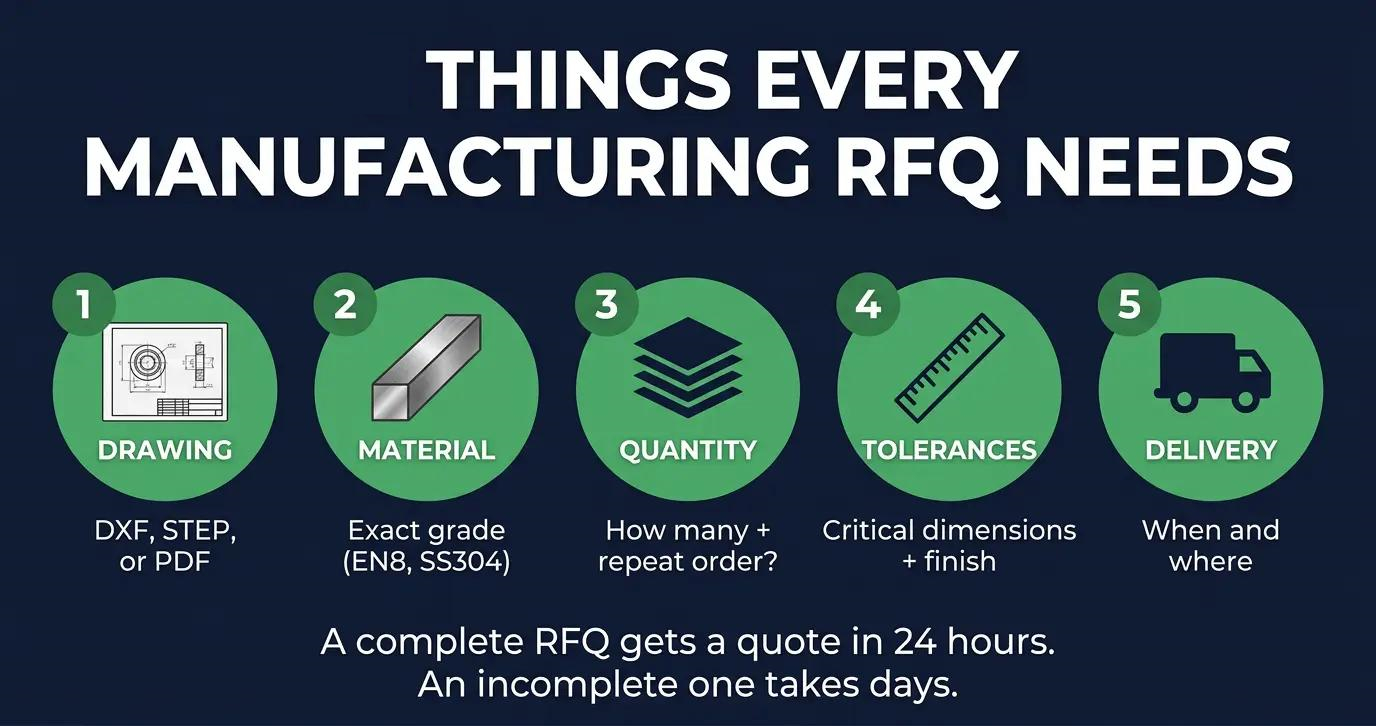
Process flowchart: the complete closed loop from RFQ to delivery
The following is our internal process for handling a standard RFQ, which you can refer to in order to understand the supplier's decision-making logic:
Stage 1: Customer submits RFQ
Includes STEP model, PDF drawing, technical requirements
Specifies quantity, delivery, material
Stage 2: Supplier internal review (24-48 hours)
Sales and engineering teams jointly review feasibility
Check drawing consistency, tolerance challenges, process difficulties
Assess whether it is a "match"—that is, whether the project requirements align with the supplier's capabilities and experience
Stage 3: DFM feedback and clarification
Provide manufacturability optimization suggestions (e.g., increase R-corner, adjust tolerances)
Confirm ambiguous features
Some suppliers provide preliminary budget pricing at this stage
Stage 4: Quote from subcontractors
If secondary processes such as anodizing, plating, heat treatment, etc. are required, request quotes from downstream partners
Stage 5: Generate quote
Combine time studies (toolpath simulation), material costs, subcontracting costs, packaging and logistics costs to generate a formal quotation
Stage 6: Customer review and order placement
Confirm delivery and quality requirements
Sign purchase order (PO)
Case study: how one RFQ reduced CNC machining costs by 22%?
A US customer sent us an RFQ for a drone motor mount part for prototype validation. During the RFQ review process, our engineering team identified three issues that would significantly drive up machining costs.
Internal corner radius too small
One non-critical position on the drawing called out an R0.5 mm internal corner. This meant that a smaller-diameter tool, such as a Ø1 mm end mill, would be required for corner cleanup. We recommended that the customer relax the internal corner radius to R1.5 mm. This would allow the use of a larger-diameter tool, a Ø3 mm end mill, improving tool rigidity, reducing machining time, and lowering the risk of tool breakage. Cost reduction: approximately 3%.
Surface roughness requirement too high
The original RFQ required all external surfaces to achieve Ra 0.8 μm. After functional evaluation, we found that only two mating surfaces actually required that roughness. Therefore, we recommended:
Critical mating surfaces: Ra 0.8 μm
Non-critical external surfaces: Ra 3.2 μm
Fewer polishing operations, cost reduction: approximately 8%.
Material selection optimization
The original RFQ only specified AL 7075 for the material, without stating the specific temper.
We recommended specifying the material as 6061-T6. In this project, the customer confirmed that 6061-T6 could meet the functional requirements of the prototype validation stage.
And 6061-T6 is easier to machine, reducing the quoted cost by 5%. After optimization, the total cost of this RFQ was significantly reduced.
More importantly, the FAI for the first trial run passed in a single attempt, with no rework or drawing modifications.
This case illustrates that the quality of an RFQ not only affects quoting speed, but also directly impacts CNC machining costs. A clear, reasonable, and manufacturable RFQ helps suppliers quote more accurately and also helps buyers avoid unnecessary machining expenses.
FAQ: Frequently asked questions about RFQs
Q1: How long does RFQ processing typically take?
A: This mainly depends on the complexity of the project.
Simple parts (e.g., plates, shafts, no complex curved surfaces): quotes can usually be completed within 1-2 working days.
Medium complexity (including multiple curved surfaces, multiple processes): generally takes 2-3 working days.
Complex parts (including deep cavities, thin walls, 5-axis simultaneous machining features, or special heat treatment requirements): may take 3-5 working days.
It should be noted that this time covers the engineering team's careful review of the drawing, manufacturability analysis (DFM), and the quotation cycle for subcontracting processes (such as anodizing, plating). We always believe that accuracy is more important than speed—a fully evaluated quote is far more valuable than a hastily given number.
Q2: What are the common reasons for an RFQ being rejected?
A: When a supplier proactively rejects an RFQ, it is actually a responsible move for both parties—it means that after carefully assessing their own capability boundaries, they have concluded that they cannot meet your requirements. Common rejection reasons include: part precision requirements exceed the supplier's equipment capability (e.g., requiring ±0.001mm tolerance but the supplier does not have the corresponding finishing equipment); the material or process is not the supplier's area of expertise (e.g., a manufacturer mainly doing aluminum parts receives an order for titanium alloy or Inconel); the order quantity is too small but the part is extremely complex, resulting in programming and fixturing investment far higher than the machining itself, making it economically unviable; the drawing has major manufacturability risks, such as extremely deep cavities, very small R-corners, or thin-wall structures, with extremely high scrap rates if forced to machine; and the supplier's current capacity is fully occupied and cannot schedule production within your required delivery date. When encountering a rejection, we recommend proactively asking for the specific reason—this can often help you understand the direction for design optimization, and you can also adjust process requirements accordingly and look for a more suitable supplier.
Q3: If I only have a physical sample and no 3D model, can I get a quote?
A: Yes, but the accuracy will be limited. It is recommended to provide at least a hand-drawn sketch or basic dimensions, and preferably a 2D drawing after scanning or simple measurement. An RFQ evaluation with a physical sample will be more accurate.
Q4: Why do quotes from several suppliers vary greatly?
A: It may be due to different interpretations of the drawing, or the use of different subcontracting resources. An experienced supplier will clarify ambiguities in advance rather than quoting based on guesswork.
Q5: How long is an RFQ quotation typically valid?
A: Usually 15-30 days, depending on raw material price fluctuations and workshop capacity conditions. RFQs that exceed the validity period are recommended to be resubmitted so that the supplier can confirm the latest situation.
Make your next RFQ more efficient
Preparing a professional RFQ is the first step in establishing efficient cooperation with your supplier. It can help you:
Obtain more accurate and more competitive quotes
Shorten the entire cycle from inquiry to order placement to delivery
Avoid manufacturability risks at the design stage and reduce overall costs
Brightstar Prototype CNC Co., Ltd always adheres to the core philosophy of "precision quality, customer first." The cooperation we understand is not a one-off transaction, but a technical partnership that runs through the entire product development lifecycle. With over ten years of precision machining experience and ISO 9001 and IATF 16949 certifications, we are your trusted rapid prototyping and CNC machining partner in China.
Send your RFQ (including STEP model + PDF drawing + technical requirements) to our business email, or submit your inquiry through our official website. We promise to provide initial feedback within 8 working hours (for regular projects), along with professional DFM optimization suggestions and a complete FAI (First Article Inspection) report.
Start now! Get a quote immediately and experience a different kind of CNC machining service.

Disclaimer
The information provided in this article is for general engineering reference only. Actual machining methods, tolerances, and manufacturing strategies may vary depending on part geometry, material condition, and application requirements. Please consult with a qualified manufacturing engineer for project-specific recommendations.